Website Cloning Service vs AI Website Cloner: Cost, Timeline, and Code Ownership
An AI website cloner is the faster self-serve option for a page you can edit yourself. A website cloning service is the better fit when you need multiple pages rebuilt, rebranded, checked, and launched without managing the migration.
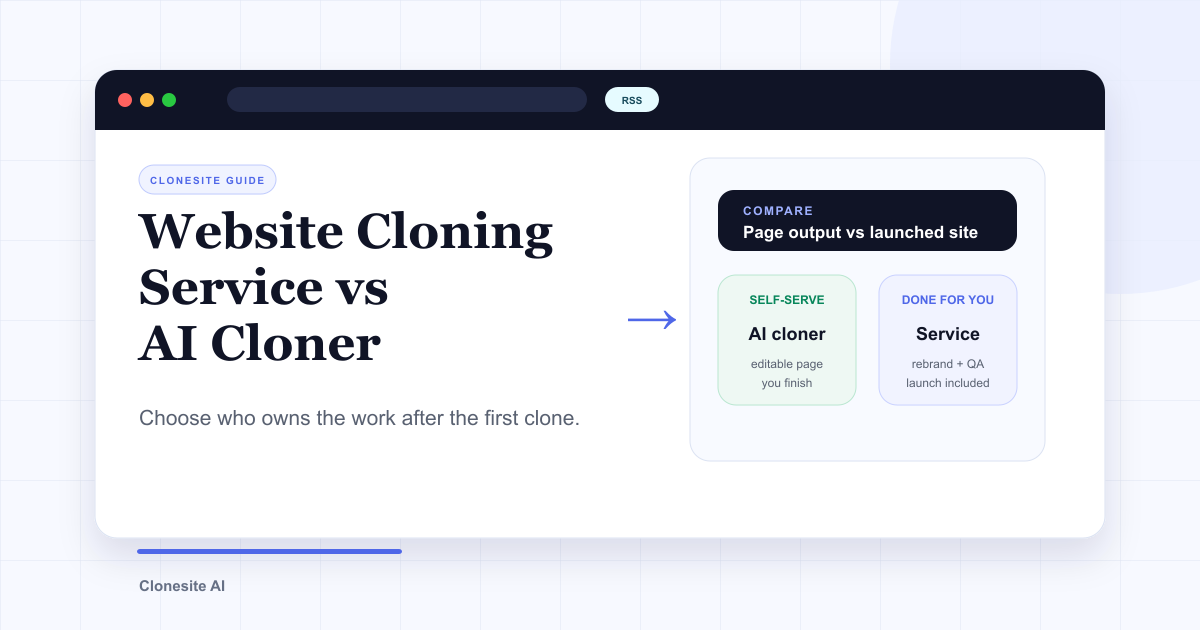
Use an AI website cloner when you want to turn one public page into editable source and are comfortable finishing the work yourself. Use a website cloning service when the real job is a site migration: several page types, a new brand, redirects, forms, analytics, quality assurance, and a launch that someone needs to own.
The difference is not mainly the technology. It is who owns the work between "the first clone is ready" and "the new site is live."
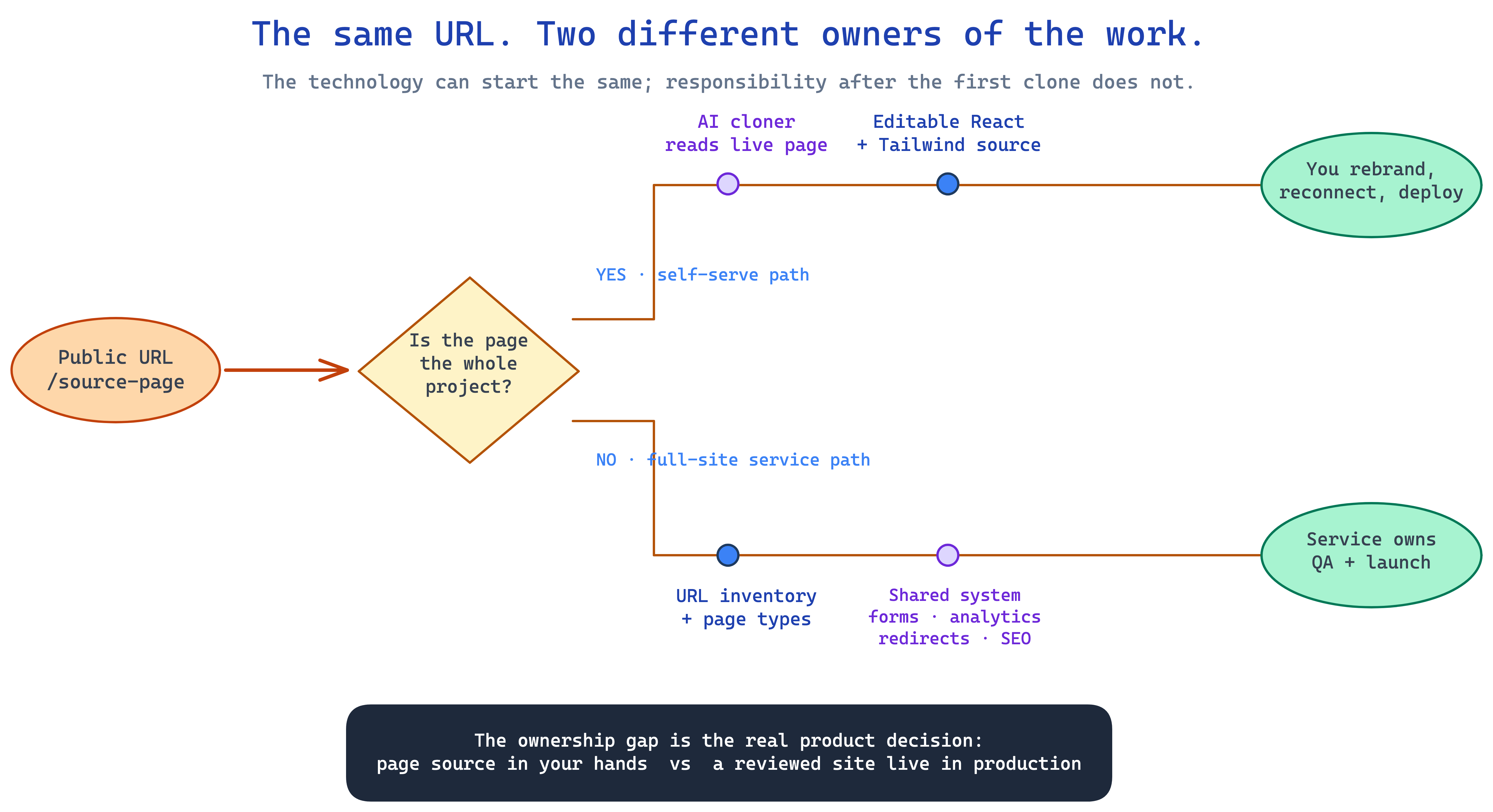
Both paths can start from the same public page. The practical difference is who owns the work after the first clone.
The short comparison
| Decision | AI website cloner | Website cloning service |
|---|---|---|
| Best for | One page or a small set of pages | A complete site or business-critical migration |
| Workflow owner | You | The service team |
| Input | Public page URL | URLs plus your brand, content, and launch requirements |
| First deliverable | Editable page source and preview | A scoped rebuild plan and completed pages |
| Rebranding | You replace copy, images, logo, and claims | Included when explicitly scoped |
| Integrations | You reconnect them | Scoped and rebuilt separately |
| SEO migration | You verify metadata and redirects | Can be included in the migration plan |
| Pricing shape | Per page or source unlock | Custom quote based on scope |
| Launch responsibility | You deploy | Can include deployment and launch checks |
Both paths can start from the same live URLs. What changes is the amount of coordination wrapped around them.
Choose an AI website cloner when the page is the project
A self-serve cloner is the direct route when you already know which page you want. Paste the URL, generate a preview, inspect the result, replace the original brand assets, and export the source.
This works well when:
- You need a landing page, pricing page, or other isolated page.
- You can edit React and Tailwind yourself or with a coding agent.
- The source page is public and does not depend on private application state.
- You are prepared to rewrite the copy and replace logos, images, claims, and customer proof.
- You control deployment and can connect forms, analytics, and other integrations.
The advantage is speed and control. You do not need a discovery project before seeing the first output, and you are not locked into a visual builder after the clone is ready. The tradeoff is that the remaining decisions are yours.
See how to clone a website from a URL for the self-serve workflow, or try the AI website cloner with a public page.
Choose a website cloning service when the system is the project
A full website is more than a folder of separately cloned pages. It has shared navigation, repeated layouts, canonical URLs, redirects, forms, analytics, structured data, and a launch order. Treating each URL as an isolated task can reproduce the pages while missing the system that makes them one site.
A service is the better fit when:
- You need several page types rebuilt under one design system.
- Nobody on your team wants to review and clean up every page.
- The brand must change across copy, images, colors, type, and proof.
- Existing URLs and organic search traffic must survive the move.
- Forms, CMS content, analytics, or other integrations need replacement.
- The new site must be tested and deployed, not merely handed over as code.
Clonesite's done-for-you path is quoted individually because those variables change the work. It can cover the public-page rebuild, rebranding, deployment, and the migration details agreed in the scope. Private backend behavior still needs its own requirements; it cannot be recovered from a public page.
Compare cost by completed outcome, not by page price
Self-serve and service pricing measure different things.
A self-serve tool charges for generation or source access. The buyer supplies the review, rebranding, integration work, deployment, and any repair passes. That is usually the economical choice when the scope is small and the buyer can do those steps.
A service quote includes human work around the generated source. The useful comparison is not "price per cloned page" but "cost to reach a reviewed, branded, working site." Before comparing quotes, write down who owns:
- The complete URL and page-type inventory.
- Copy, image, logo, and claim replacement.
- Responsive checks across representative pages.
- Forms, analytics, CMS, search, and other integrations.
- Redirects, canonical tags, sitemap, and launch sequencing.
- Deployment, rollback, and post-launch fixes.
If those items are outside the quote, they remain your work. Current self-serve rates are on the pricing page; full-site work is scoped separately.
Ask what you own when the work is finished
"Website clone" describes the process, not the deliverable. Before choosing a tool or service, ask:
- Do I receive editable source code or a project locked to your platform?
- What framework and styling system does the source use?
- Can I deploy it to my own Cloudflare, Vercel, Netlify, or other host?
- Are fonts, images, and other licensed assets cleared for my use?
- Who replaces the original brand copy, screenshots, and claims?
- Which backend behavior is explicitly included?
- What happens when a page fails visual or responsive review?
Clonesite outputs editable React and Tailwind source. That makes the frontend portable, but it does not transfer ownership of the source site's logo, copy, photos, trademarks, or private application logic. The safe workflow is always to use the layout as a scaffold and make the published result your own. Our guide to cloning a website legally explains that boundary.
A simple decision rule
Choose the self-serve cloner if you can say: "I need this page as editable code, and I can take it from preview to launch."
Choose the service if the honest requirement is: "We need this website rebuilt and launched, and we need one owner for the migration."
If you are still deciding whether the scope is one page or a whole site, use the single-page vs full-site cloning guide. If the full-site path fits, contact Clonesite with the current domain, the pages you need, and the launch outcome you want.
FAQ
What is the difference between a website cloning service and an AI website cloner?+
An AI website cloner is a self-serve tool that turns a public page URL into editable source you review and finish yourself. A website cloning service handles the larger job for you, including page inventory, multi-page rebuilding, rebranding, quality checks, redirects, and deployment.
When should I use an AI website cloner?+
Use an AI website cloner when you have one page or a small set of pages, can review and edit React and Tailwind source, and want the fastest route from a live URL to an editable starting point.
When should I hire a website cloning service?+
Hire a service when the work includes a whole site, shared navigation and footer systems, forms, redirects, analytics, SEO checks, or a launch that someone needs to own end to end.
How much does website cloning cost?+
Self-serve cloning is usually priced per page or source unlock, while a full-site service is quoted from the number of page types, migration complexity, integrations, rebranding work, and launch requirements. Clonesite publishes current self-serve pricing and quotes full-site work separately.
Do I own the code after a website is cloned?+
Ownership depends on the deliverable. Ask whether you receive editable source, what framework it uses, whether it runs without the vendor, and whether you can deploy it anywhere. Clonesite delivers editable React and Tailwind source rather than a locked visual-builder project.
Can a website cloning service copy backend features too?+
Not automatically. A public URL exposes the rendered frontend, not private databases, authentication rules, checkout logic, CMS workflows, or internal APIs. Those systems must be scoped and rebuilt separately.