Is It Legal To Clone a Website?
What is safe to reuse when cloning a website, what must be replaced, and how to use a cloned page as a scaffold instead of a copy.
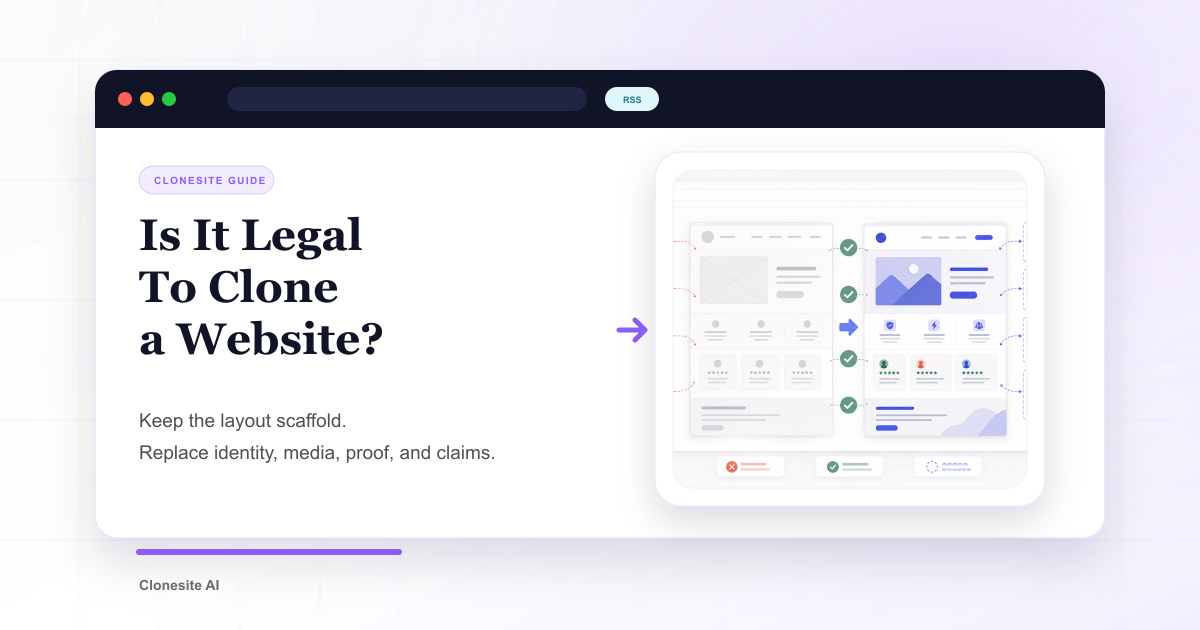
Cloning a website is safest when you treat the result as a scaffold, not a finished page.
Layout patterns are common across the web. Brand assets are not. The practical rule is to keep the structure you need and replace the identity, claims, media, and proof that belong to someone else.
This guide is practical orientation, not legal advice. For a specific commercial launch, talk to a lawyer qualified in your jurisdiction.
The key distinction: expression vs. idea
Copyright protects expression, not ideas. A page's layout — a hero on top, a logo strip below it, three feature columns, a pricing table, a footer — is an idea, and ideas are free to reuse. That is why a thousand SaaS sites share the same general shape without infringing each other.
What copyright protects is the specific expression: the original copy a company wrote, the photographs they commissioned, the illustrations they drew, the particular way their hero is art directed. You can borrow the pattern. You cannot borrow the words and the pictures.
Trademark adds a second layer. A brand's name, logo, tagline, and distinctive product names are protected as identifiers of origin. Even if you rewrite every word, republishing a page that still carries someone's logo or trademarked product name can mislead visitors about who made the page.
What you can use as a starting point
A cloned page can help you understand structure:
- How the hero is arranged.
- How much copy appears above the fold.
- Where CTAs sit.
- How sections stack on mobile.
- How product proof appears next to the offer.
- How the type scale and spacing hold the page together.
Those patterns are useful because they reduce blank-canvas work. Studying a page that already converts is a legitimate way to choose your own layout. The structure is the starting line, not the finish.
What you must replace
Before publishing, replace anything that makes the page another company's property or voice:
- Logo and favicon.
- Company and product names.
- Original marketing copy.
- Screenshots and customer logos.
- Photos and illustrations.
- Trademarked phrases and taglines.
- Unique claims or pricing statements.
- Color combinations that function as trade dress for that brand (when in doubt, pick your own accent).
This is not just a legal hygiene step. It also improves conversion because the page starts speaking to your audience instead of borrowing someone else's story. A page that sounds like someone else rarely earns trust from your customers.
Trademarks, not just logos
Logos are the obvious trademark, but they are not the only one. Product names, slogan taglines, and even distinctive feature names can be protected. If a competitor calls their dashboard "Command Center," you should not ship a page advertising your own "Command Center" even with a different logo.
The safe move is to rename every product surface and feature with your own language before the page goes live. Borrowed structure with your own naming is a page. Borrowed naming is a conflict, regardless of how different the rest of the page looks.
Screenshots vs. source code
There is a practical difference between saving a screenshot of a site and rebuilding its source.
A screenshot is a fixed image of one moment on one device. It captures the look but none of the working parts. Reusing a screenshot in your marketing is reuse of someone else's visual expression, and the original page's owner can object.
Rebuilt source is different. When a cloner reads a public page's structure and regenerates it as editable components, you get the layout pattern without the original's protected assets. The moment you swap in your own copy, images, and brand, the result is your page — built on a borrowed pattern, which is exactly what most of the web already is.
This is why source code is more useful than a screenshot for building a new site. You can edit the page until the brand, copy, and proof match your product, instead of trying to scrub a flat image clean.
Cloning for inspiration and study
Studying a site you admire is standard practice in design. Most landing pages are built on patterns borrowed from pages that worked before them. The line between inspiration and infringement is drawn at assets, not at patterns.
Safe inspiration looks like this: you notice a site uses a single accent color and a serif headline, and you apply the same kind of decision to your own page with your own color and your own copy. Unsafe inspiration looks like this: you reproduce the same hero with the same image, the same headline rhythm, and the same product name, then publish it as your own.
The first is how design has always worked. The second is copying.
The safer workflow
Use the clone as a working base:
- Paste the source URL.
- Generate an editable preview.
- Keep the layout and component structure.
- Replace the brand assets, copy, images, and claims.
- Rename any trademarked product or feature names.
- Export the source only when the page is clearly yours.
That workflow is why source code is more useful than a screenshot. You can edit the page until the brand, copy, and proof match your product. For the broader flow of turning a URL into editable source, see our guide to cloning a website from a URL.
When in doubt
If you are unsure whether a specific element is safe to reuse, the safest move is always to replace it. The cost of writing your own copy or commissioning your own image is small compared to the cost of a dispute after launch. When the stakes are real — a paid campaign, a commercial product page, a client deliverable — get a lawyer to review the page before it ships.
Borrow patterns. Replace assets. Ship your own page.
FAQ
Is it legal to clone a website?+
Cloning a website is legal when you treat the result as a scaffold. Layout patterns are common across the web and are not protectable on their own. You must replace the original brand assets, copy, images, and claims before publishing the page as your own.
Can I copy a website's design?+
You can borrow layout patterns and structural decisions, which are not protected by copyright. You cannot copy a site's specific visual expression — its original artwork, photography, marketing copy, or brand identity — without permission.
What is the difference between cloning and copying a website?+
Cloning rebuilds a page's structure as editable source so you can replace the brand and ship your own site. Copying republishes someone else's page, assets and all, which is usually a copyright and trademark violation.
Can I use a cloned website commercially?+
Yes, once you replace every brand asset, line of original copy, image, and claim with your own. The cloned structure is a scaffold; what you publish must be your own work.
Do I need permission to clone a website?+
You do not need permission to fetch and rebuild a public page's structure for your own editing. You do need to replace the original brand assets and protected expression before publishing, regardless of how the page was built.
Is this guide legal advice?+
No. This guide is practical orientation, not legal advice. For a specific situation, especially a commercial launch, consult a lawyer qualified in your jurisdiction.
Related guides
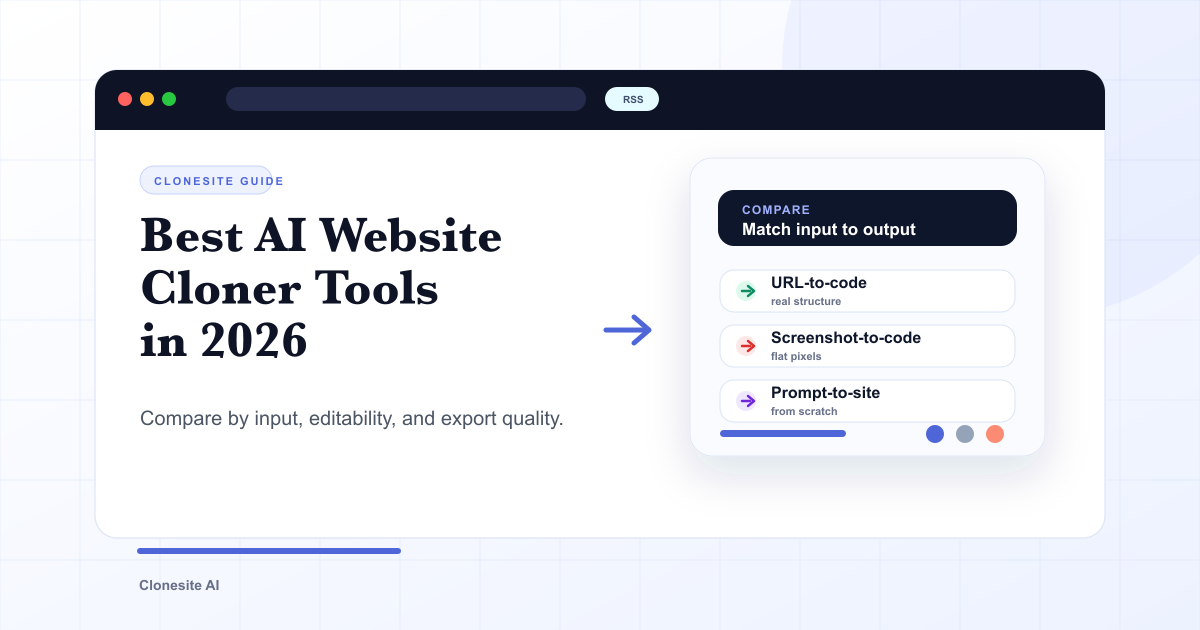 Best AI Website Cloner Tools in 2026The best AI website cloner is the one whose input and output match your job — URL-to-code for reusing a real layout, screenshot-to-code for a static mockup, and prompt-to-site for building from scratch. Compare them by input type, editability, and export quality before you pick.
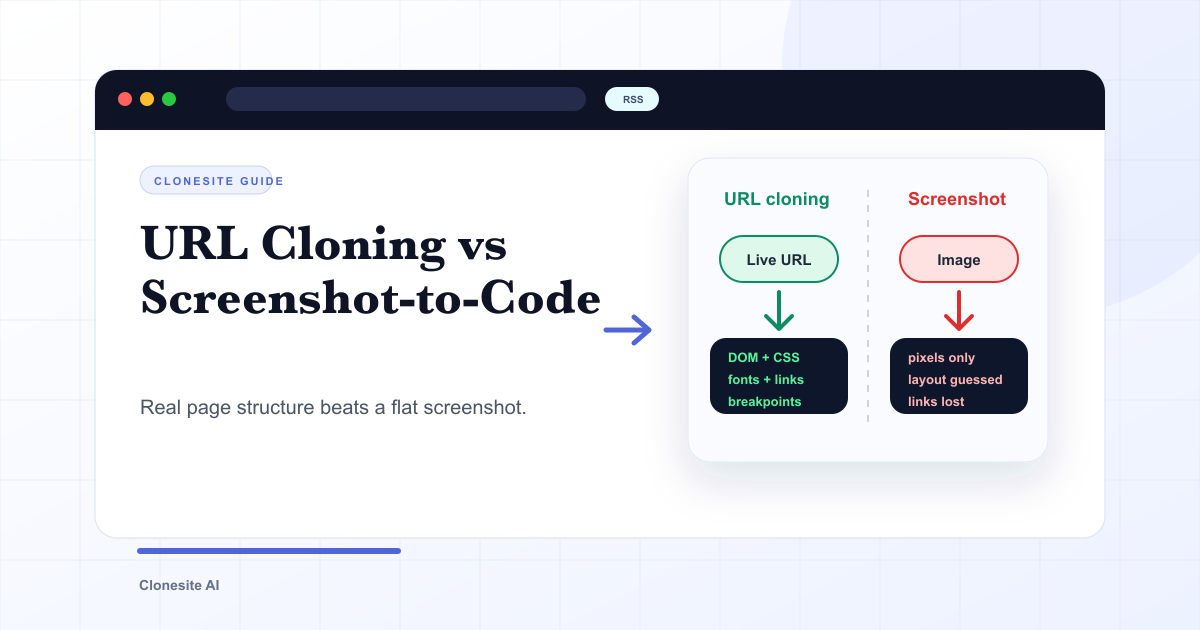 URL Cloning vs Screenshot-to-Code: What Actually Changes in the OutputURL cloning reads a live page's real structure — DOM, CSS, fonts, links, and responsive breakpoints — and rebuilds it as editable code. Screenshot-to-code only sees pixels, so it infers layout and loses fonts, links, and responsiveness. The difference shows up directly in how usable the output is.
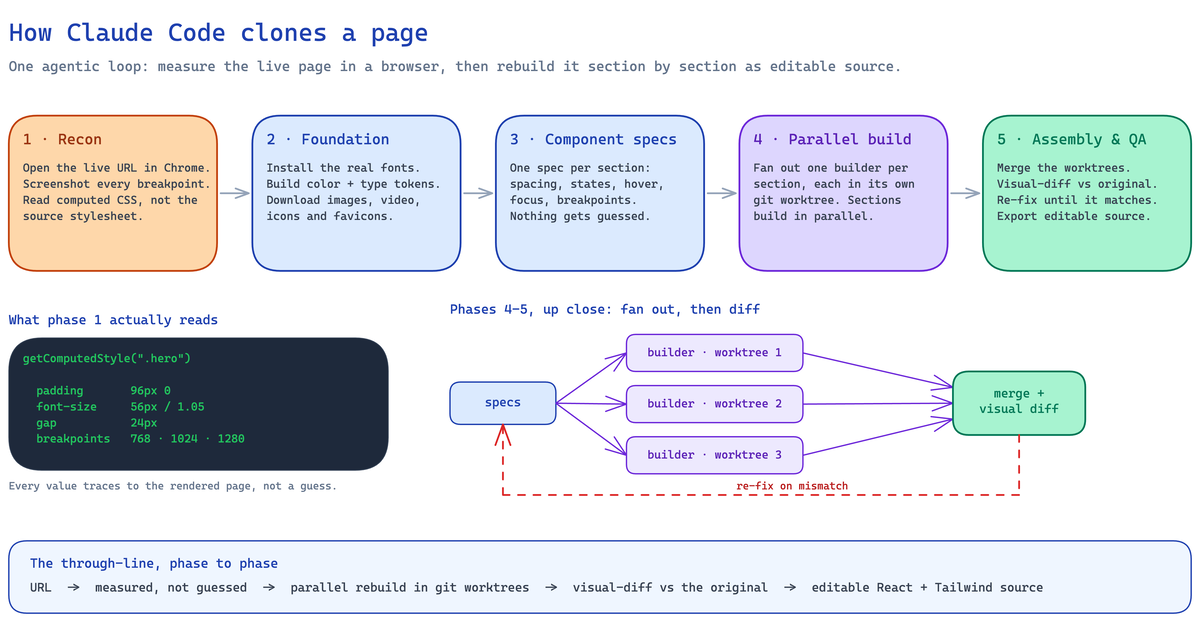 How to Clone a Website With Claude Code (2026): The Real Pipeline, and Where It BreaksA builder's guide to cloning a website with Claude Code — the five-phase agentic pipeline that measures a live page and rebuilds it as editable React and Tailwind source, the setup it needs, the sites where an unattended run breaks, and when to run it hosted instead.